Round Flow, Slot Games
How round flow works for slot games, UPI details, realistic timings and the pitfalls to avoid.
What is Round Flow?
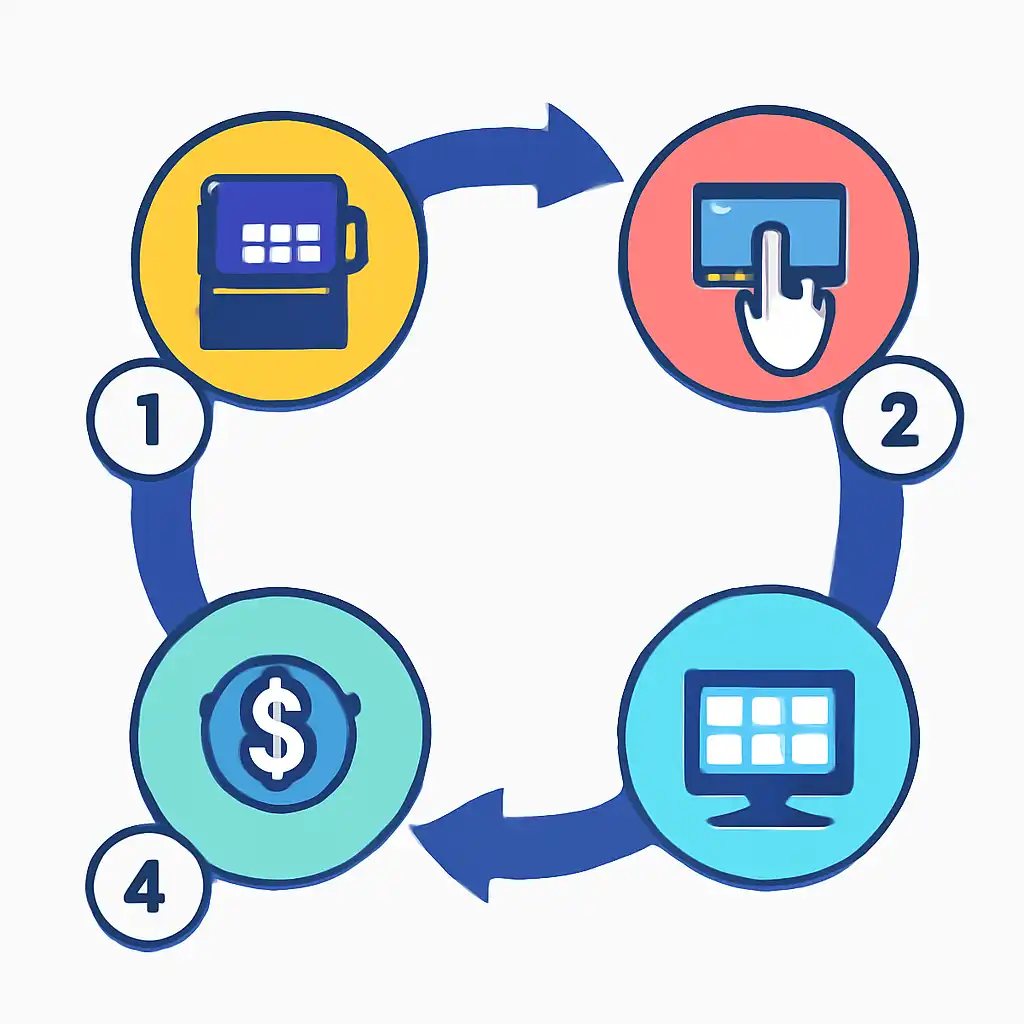
Round flow is the complete sequence of actions that takes place between the moment you confirm a bet and the moment the game returns control to you for the next spin. In slot games on slot-to-win.com, every round follows a defined pipeline: bet lock → reel spin → symbol evaluation → win calculation → payout credit → round end. Nothing in that chain is random in ordering, only the reel outcomes are governed by the RNG.
Understanding round flow matters because it directly affects three things you care about as a player. First, speed: knowing which phase you are in tells you why the UI is temporarily unresponsive. A 1 to 3 second freeze during a feature trigger is normal phase 5 processing, not a crash. Second, bonus triggers: free spins, multipliers, and pick-bonus games all fire at specific points inside the flow, not after it.
Scatter symbols, for example, are counted during the evaluation phase, meaning by the time the third scatter lands visually on the reel, the server has already confirmed the free spin award. Third, auto-play limits: loss limits and win caps are checked at the evaluation phase, so the round that breaches a limit still completes in full before auto-play halts, preventing the false impression that the game kept going past your limit.
Round flow is distinct from a game session (your entire sitting at a title) and from spin sequence (the statistical distribution of outcomes across many rounds). It refers strictly to the anatomy of one single slot round, typically 2 to 8 seconds from button press to spin-button unlock on a standard base game spin, and 15 to 90 seconds when a free spin feature is involved. In the Indian online gaming context, round flow also intersects with wallet transaction timing.
When you deposit via PhonePe, Google Pay (GPay), or BHIM UPI, funds appear in your slot wallet within 5 to 30 seconds on average. That credited balance is what the game debits at the start of phase 1. If you spin immediately after a UPI top-up and the wallet has not yet refreshed, the game will reject the round at bet confirmation, this is a balance-sync issue, not a round flow fault.
Waiting 15 seconds after any UPI deposit before spinning eliminates this edge case entirely. Compared to table games like roulette or blackjack, where round flow is highly variable because it depends on live dealer actions, slot round flow is deterministic in structure. Every spin of a given title takes the same six-phase route, which is one reason slot games consistently account for over 60% of total game sessions on most platforms that publish engagement data.
How Round Flow Works
A single round in a standard video slot on this site moves through six discrete phases. Each phase has a fixed duration or a conditional exit point. Understanding each one lets you read the game's UI accurately and anticipate exactly where features will appear.
- Bet confirmation (0 to 50 ms): You press Spin or Max Bet. The game debits your stake from your balance immediately and locks the spin button. If your balance is insufficient, the round never opens; the game returns an error before phase 2 begins. On titles with adjustable paylines, your active line count and coin value are locked in at this exact moment, changing them mid-animation is not possible.
- RNG call and reel stop assignment (50 to 250 ms): The server-side RNG generates a result in milliseconds. The visual spinning of the reels is animation only; the outcome is already determined before a single reel appears to move on your screen. This phase typically completes in under 200 ms on a stable 4G or Wi-Fi connection. On congested mobile networks, common during peak evening hours in metro areas like Mumbai, Delhi, and Bengaluru, this phase can stretch to 400 to 800 ms, which manifests as a slight reel-spin delay. The round result itself is unaffected; only the animation start is postponed.
- Reel animation (800 ms, 3,000 ms): Reels decelerate and land on their assigned stop positions in sequence, usually left to right. On most titles, you can speed this up by pressing Spin again during animation or by enabling Turbo mode before the spin. Turbo mode typically cuts animation time by 40 to 60%, bringing a standard spin from roughly 2.5 seconds down to 1.0 to 1.2 seconds. The earliest the next phase can start is when all reels have visually stopped. This phase has no effect on the outcome whatsoever, it is purely visual feedback designed to build anticipation.
- Win evaluation (50 to 200 ms): The engine checks every active payline or cluster (depending on whether the title uses payline mechanics or cluster-pays mechanics) for matching symbol combinations. Wild substitutions, scatter counts, and bonus symbol tallies are all resolved here simultaneously, not sequentially. On a 5×3 reel grid with 25 paylines, the engine evaluates all 25 lines in a single pass. The win display, the highlighted paylines, the flashing symbols, is the visual output of this phase. A no-win result completes this phase in under 50 ms; a complex multi-line win with several wild substitutions may take 150 to 200 ms.
- Feature resolution (variable: 2 seconds, 3 minutes): If the evaluation phase detected free spins, a pick-me bonus, a re-spin trigger, or a cascading-reels chain, those features execute before any payout is credited to your balance. Free spin sub-rounds each run their own mini round flow internally, phases 2 through 5 repeat for each free spin awarded. This is why triggering 15 free spins with a ×3 multiplier visibly takes 30 to 90 seconds to complete, while a no-win base spin ends in under 3 seconds. Cascading or avalanche mechanics can chain indefinitely within a single round if each cascade produces a win, extending phase 5 unpredictably.
- Payout credit and round close (500 ms, 2,000 ms): Total winnings from base symbols plus any feature payouts are added to your balance in a single credit event. The win counter animates up from zero to the final figure, this animation takes longer for larger wins, sometimes 1 to 2 seconds for a win above 100× your bet. Once the counter reaches its final value, the spin button unlocks and the next round can begin. This animation can be skipped on most titles by pressing Spin, which simultaneously credits the win and opens the next round's phase 1.
One practical implication of this six-phase structure: if you close the browser or lose your connection during phases 2 to 5, reputable licensed slots restore your session to the exact round state when you reconnect. Your stake is never silently forfeited mid-round. When you reopen the game after a disconnect, expect a 3 to 8 second reconnection check before the round resumes or completes automatically. This session-restore behaviour is a regulatory requirement on platforms operating under legitimate licensing frameworks, and all titles on slot-to-win.com comply with this standard.
Round flow vs. hold percentage, a common misconception
Many players assume the game "decides" to pay or withhold based on recent round history, a belief sometimes called the "hot machine" or "cold machine" fallacy. Round flow does not work this way. Each phase 2 RNG call is statistically independent of every previous call. The RTP (return-to-player) percentage, typically 94%, 97% on the titles offered here, is a mathematical expectation across millions of rounds, not a round-by-round governor. No phase in the flow references prior outcomes. Choosing when to spin based on recent history has zero effect on phase 4 win evaluation results.
Round Flow on Mobile
Playing slot games on a mobile device on slot-to-win.com does not change the server-side round flow, all six phases execute identically. What changes is how the client-side animation layer responds to your hardware, screen size, and network conditions. Indian players predominantly access online slot games via Android smartphones, making mobile-specific round flow optimisation directly relevant to the majority of this site's audience.
Touch input and button timing
On touchscreen devices, the Spin button registers on touch-start rather than touch-end on most modern slot engines, shaving 80 to 150 ms of perceived lag compared to a mouse click-release on desktop. However, if you tap rapidly between rounds, the game ignores secondary taps during the bet-lock window (the first 50 ms of phase 1) to prevent double-spend errors. A brief visual feedback pulse, usually a button colour shift or a subtle haptic vibration on supported Android devices, confirms your tap was registered. If you see no feedback, the round did not open; verify your balance before tapping again.
Animation frame rate and round length
Phones running at 60 fps, including mid-range Android devices like the Redmi Note series or Realme 9 series, among the most common handsets for online gaming in India, display reel animations at full quality. On older devices that drop below 30 fps under load, some titles automatically reduce reel spin duration by 20 to 30% to keep the round feel snappy. Flagship devices (OnePlus 12, Samsung Galaxy S24) running at 90 to 120 Hz produce noticeably smoother reel deceleration animations, though this has zero effect on RNG timing or payout amounts.
If you play on a lower-end device and the animations feel choppy, enabling the in-game "Low Quality" or "Performance Mode" graphic setting, available in the settings menu of most modern slot titles, restores smooth round flow by reducing texture resolution without altering game mechanics.
Network conditions and phase 2 delays
Phase 2 (the RNG server call) is the only phase directly dependent on your internet connection. Here is how common Indian connection types compare for this phase:
- Jio 5G / Airtel 5G (sub-6 GHz): Phase 2 latency typically 30 to 80 ms. Virtually unnoticeable delay. Best option for uninterrupted round flow.
- 4G LTE on Jio / Airtel / Vi: Phase 2 latency 80 to 200 ms under normal load; spikes to 400 to 900 ms during peak evening hours (7 pm to 11 pm IST) in dense urban areas.
- Home broadband (Jio Fiber, ACT, Hathway): Phase 2 latency 15 to 50 ms. Most consistent performance; recommended for extended sessions or high-stake rounds.
- 2G / E / H+ fallback: Phase 2 latency 800 ms, 3,000 ms. Reel animations visibly stutter; the game may display a loading spinner between spins. Avoid real-money play on 2G connections.

Background tab behaviour
If you switch to another app, checking a PhonePe transaction, responding to a WhatsApp message, opening GPay to verify a deposit, or lock your screen mid-round, the browser pauses JavaScript timers. When you return, the game reconnects, fetches the completed round result from the server, and plays a compressed win animation before unlocking the next spin. You will not miss a win. The round was already resolved server-side while your screen was off.
This is particularly relevant for Indian users who frequently cross-check their BHIM or PhonePe wallet balance mid-session: switching apps during a free spin feature will not cancel the feature, return to the browser and the result will be waiting.
Tips for cleaner round flow on mobile
- Enable Turbo or Quick Spin in the game settings to cut reel animation time by up to 50%, making sessions faster without any effect on outcomes.
- Use a Wi-Fi connection for free spin features; a dropped 4G packet during phase 5 causes a reconnect delay that makes large feature rounds feel sluggish and occasionally displays a "Restoring Session" overlay.
- Disable battery saver mode before starting a slot session, battery saver throttles CPU clock speed on most Android phones, which extends animation rendering time without changing any actual odds or payouts.
- Close other background apps before playing on devices with less than 3 GB RAM. Slot game assets require sustained memory; a RAM-starved browser will drop frames and occasionally force a full game reload mid-session, interrupting round flow at phase 3 or 5.