Chasing Losses, Slot Games
Chasing losses for slot games players in India, how it works, what it costs and how long it takes.
What is chasing losses?
Chasing losses is the impulse to keep playing, or to increase your stake, specifically because you want to recover money you have already lost. In the context of slot games it is one of the most common and most dangerous patterns a player can fall into, because the mechanics of every spin are mathematically independent. The outcome of your next spin is not influenced by how much you lost on the last hundred spins, yet the brain's loss-aversion instinct insists that a win must be "due."
The psychology behind chasing is well-documented. When you lose, the brain registers it as an unresolved problem and pushes you to fix it. Slot games, with their fast spin rates, near-miss animations and variable reward intervals, are particularly effective at sustaining that "just one more spin" feeling. Before you realise it, a session you planned to end at a comfortable stop-loss point has stretched far beyond your original budget.
Recognising chasing behaviour is the first step to managing it. Key warning signs include:
- Depositing extra funds after losing your initial session budget.
- Increasing your stake per spin after a losing streak, for example, moving from ₹2 per spin to ₹10 per spin, specifically to "win back faster."
- Feeling irritable or anxious if you stop before recovering losses.
- Telling yourself the session will end only when you are "back to even."
- Playing on a game you dislike purely because you lost money on it and feel you are owed a win.
It is equally important to understand why chasing rarely works mathematically. Every licensed slot game has a built-in Return to Player (RTP) percentage, commonly published between 94% and 97% for popular titles. RTP describes the long-run average payout across millions of spins for all players combined, not a guarantee of your individual session outcome. Trying to chase a short-term loss against a negative-expectation game is statistically equivalent to trying to outrun a tide: you may get a brief reprieve, but the house edge keeps pulling.
If you believe your chasing behaviour has moved beyond an occasional impulse into something that feels compulsive, the right resource is a certified helpline. In India, the iCall service run by the Tata Institute of Social Sciences (TISS) provides confidential psychological counselling; their contact details are published on the official TISS website. The National Problem Gambling Helpline in many jurisdictions, and organisations such as Gamblers Anonymous India, are additional starting points you can locate by visiting their respective official websites directly.
Chasing losses on mobile
Mobile devices have made slot games available at any moment, on a commute, during a lunch break, or late at night when judgement is impaired by tiredness. This always-on availability is the single biggest reason mobile play amplifies chasing behaviour beyond what a desktop session typically produces.
Several features of mobile slot apps specifically feed the chasing loop:
Push notifications
Licensed operators frequently send notifications after a losing session, promotional bonus alerts, free-spin offers or "we miss you" messages. These are timed to arrive when you are most likely to be vulnerable. The offer type involved is usually a reload bonus or a loss-rebate scheme: the operator returns a percentage of net losses as bonus credits, subject to wagering requirements. Understanding how this offer type works is important before you act on it.
A loss-rebate bonus does not restore your cash; it gives you bonus funds that must be wagered a set number of times before any winnings can be withdrawn. If you were chasing losses before the bonus arrived, the wagering requirement simply extends the session further, often deepening the hole rather than filling it. Always read the full bonus terms on the operator's own promotions page before opting in.
One-tap deposits
Saved UPI IDs and stored card details reduce the psychological friction of adding funds. The moment between feeling the urge to deposit and the money actually arriving in your wallet can be as short as a few seconds on mobile, far too short for rational reflection to kick in. Removing saved payment methods when you are in a calm state is a practical preventive measure.
Portrait-mode immersion
Mobile slot games are optimised for portrait mode, filling your entire field of vision. There is no peripheral view of a clock, no nearby person to notice you have been playing for hours. Setting your phone's screen-time or app-timer controls before you begin a session gives you an external alarm that does not rely on your own willpower mid-session.
Session-time blindness
Because mobile sessions are often started in small pockets of time and then resumed, players frequently lose track of total accumulated play time across a day. Many licensed operators are required by their regulator to display session duration on-screen; if this feature is available in the app you use, enabling it is strongly recommended. For India-facing platforms, check whether the operator holds a valid licence from a recognised jurisdiction (such as Malta, Gibraltar or Curaçao) and review their responsible gambling tools section, which reputable operators publish prominently.
Chasing losses step by step
Understanding the typical anatomy of a chasing episode helps you identify exactly where to intervene. The following describes how a session commonly escalates, not to normalise it, but to make each decision point visible so you can act before the next one arrives.
Step 1, The trigger loss
A session starts within budget. An early loss, perhaps a bonus feature fails to trigger across many spins, or a high-variance game hits a long cold streak, creates a deficit relative to where the session started. At this point the player is still within their pre-set limit, but the emotional discomfort of being "down" has begun.
Intervention point: Remind yourself before every session that any amount you load is money you are prepared to lose entirely. A loss at this stage is a normal outcome, not a wrong that needs correcting.
Step 2, Rationalising a stake increase
The player reasons that raising the stake per spin will recover the deficit more quickly if a win arrives. For illustration only: if a player was wagering a modest amount per spin and doubles their stake, the maths feel intuitive, half as many wins needed to get back to even. What the reasoning misses is that each spin at the higher stake also loses at the same rate, so the downside accelerates identically. The larger the stake, the more each losing spin costs, and the deficit can widen far faster than the original pace.
Intervention point: Create a house rule before you play, stake levels do not increase during a session, ever. Write it down. Tell someone you trust.
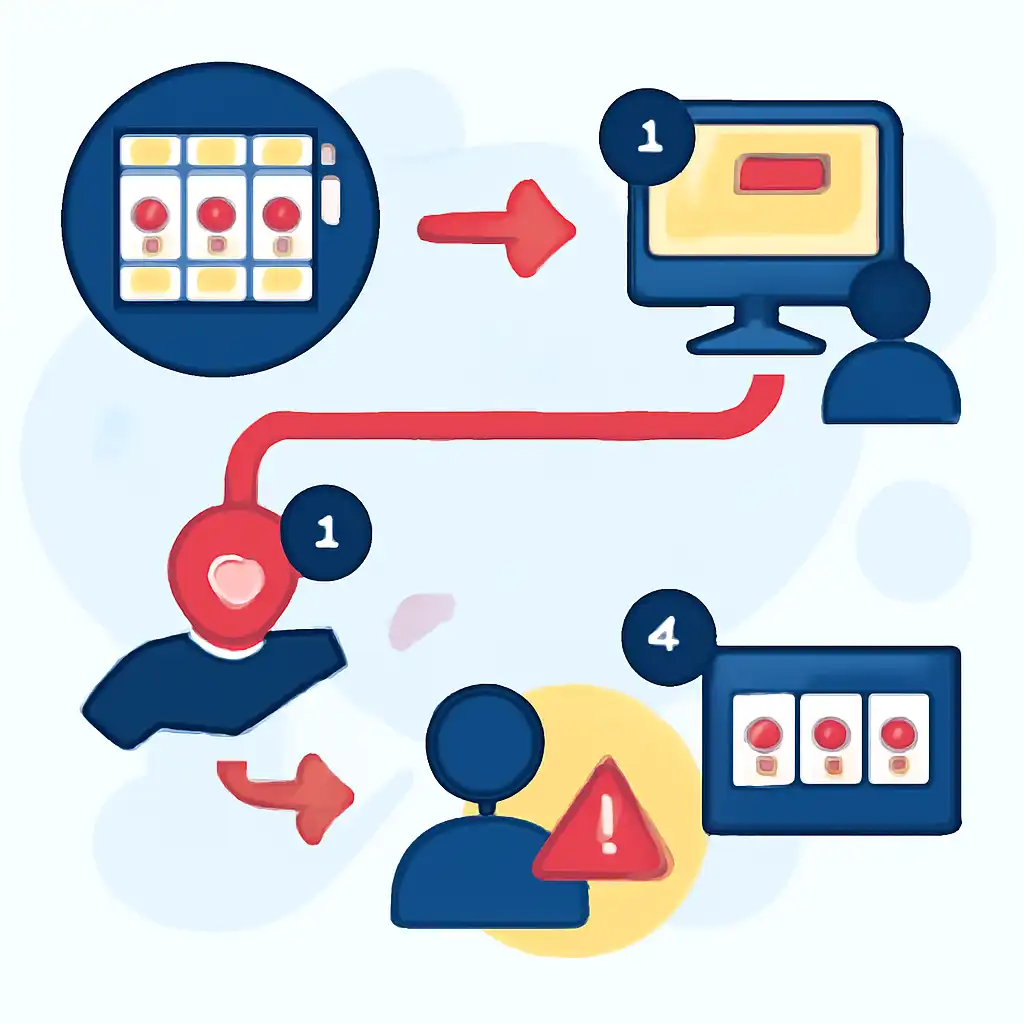
Step 3, The secondary deposit
The original session budget is exhausted. Rather than ending the session, the player makes an additional deposit, often mentally earmarked as "the last one." This is the clearest behavioural marker of chasing and the most important point at which to stop. No subsequent spin has any memory of previous spins; topping up to chase does not change the game's RTP or your statistical position.
Intervention point: Use your operator's deposit limit tool, available in the responsible gambling or account settings section of any well-regulated platform, to set a daily or weekly maximum before you start playing. This limit takes effect with a cooling-off delay on most platforms, meaning you cannot override it in the heat of the moment.
Step 4, Distorted bonus interpretation
During a long losing streak, players frequently misread how bonus features work. Because high-variance slots can go many spins between bonus triggers, the exact number varies by game RTP, volatility rating and the specific trigger probability published in the game's paytable, a player who has not yet seen the bonus in a lengthy session may believe one is statistically "overdue." Slot RNG (Random Number Generator) systems are certified to produce independent outcomes on every spin; no debt of good luck accumulates.
The game's paytable and volatility information are normally accessible via the information or rules icon within the game itself; reading these before playing tells you what to realistically expect.
Intervention point: Check the game's paytable before your session, not during it. Knowing the published bonus trigger frequency in advance reduces the shock of a long wait and makes it less likely you will interpret a dry spell as a signal to keep going.
Step 5, The exit that never comes
The player sets a mental recovery target, "I'll stop when I'm back to where I started", that keeps moving. If a partial recovery occurs, the target resets to the full original loss. If losses deepen, the target inflates. Sessions that have no fixed time or loss limit rarely end on the player's terms.
Intervention point: Replace recovery targets with time limits and loss limits set in advance. When the alarm goes off or the limit is hit, close the app. Responsible gambling tools built into licensed platforms, self-exclusion, cool-off periods, reality checks, exist precisely for this step.
Chasing losses tips and FAQs
Set limits before you load funds, not after
Every regulated slot games platform is required to offer deposit limits, loss limits and session time limits. Configure these when you are calm, not mid-session. Limits set in advance cannot be raised instantly; most platforms impose a mandatory waiting period of 24 hours or more before an increase takes effect, giving you time to reconsider.
Use a dedicated play bankroll
Keep your slot games budget entirely separate from your everyday spending account. Transfer only the amount you are genuinely comfortable losing in full for that month. When that amount is gone, the session ends, there is nothing else to access.
Treat each session as its own unit
Losses from previous sessions are sunk costs. Starting a new session specifically to recover money lost last week is chasing, even if it feels like a fresh start. Each session should begin with its own fresh budget and its own fresh mindset.
Learn the game's volatility before you play
High-volatility slot games pay out less frequently but in larger amounts when they do pay. Low-volatility games pay more frequently but in smaller amounts. Neither is inherently better, but mismatching volatility to your session budget is a common source of frustration that feeds chasing. A high-volatility game played with a budget sized for a low-volatility game will almost certainly exhaust funds before a significant win arrives. Game volatility ratings are typically stated in the official game information panel.
Take a physical break
Closing the app and leaving the room for fifteen minutes is not a trick, it is a neurological reset. The urgency that drives chasing diminishes significantly when you are no longer looking at the game. Many players report that after a short break the impulse to continue has faded entirely.

Is chasing losses always a sign of a gambling problem?
Not necessarily. A single episode of playing a few extra spins after a disappointing session is common and does not by itself indicate a disorder. The concern arises when chasing becomes a pattern, when it happens most sessions, when it overrides pre-set limits, or when stopping feels genuinely distressing. If you recognise a pattern, speaking to a counsellor is appropriate and confidential.
Can a bonus offer help me recover losses safely?
Bonus offers, reload bonuses, free spins, loss-rebate credits, can extend play time, but they do not alter the underlying mathematics of the game. A loss-rebate offer, for example, returns a percentage of net losses as bonus credits that carry wagering requirements. This means the credits must be bet a specified number of times before withdrawal. If you are already in a chasing mindset, accepting such an offer tends to prolong the session rather than resolve the deficit. Read every bonus's full terms and conditions on the operator's official promotions page before opting in.
Do slot games owe me a win after a long losing streak?
No. This belief is known as the gambler's fallacy. Each spin on a certified RNG slot game is statistically independent. The game has no memory of previous outcomes and no mechanism to compensate for past results. A long losing streak makes the next spin neither more nor less likely to pay out than it would have been on spin number one.
What tools do licensed operators provide to help?
Regulated operators are generally required to offer: deposit limits, loss limits, wager limits, session time limits, reality-check pop-ups, self-exclusion (temporary or permanent) and cool-off periods. These tools are found in the responsible gambling or player protection section of your account. In India, operators licensed in major jurisdictions typically display a responsible gambling page; if you cannot locate it, contact the operator's support team directly and ask.
Where can I get help if chasing feels out of control?
Several organisations offer confidential support. Gamblers Anonymous India holds regular meetings and publishes contact information on their official website. The iCall psychological counselling service operated by the Tata Institute of Social Sciences (TISS) can be reached via the TISS official website. BeGambleAware, while primarily UK-focused, publishes globally accessible self-help resources at their official website. Your operator's responsible gambling page will also list verified helplines relevant to your region.